

When agency owners aren't making as much profit from their business as they'd like, the first instinct is often, "I need to sell more business!" (followed by an internal groan) However, as we all know, finding new clients isn't exactly easy. If you're already struggling to make a decent profit on your existing clients, adding more might mean more work, more headaches, and not a whole lot more money.
This post explores another option. Let's keep more of the money you're already earning from your existing clients.
Most agency owners who hire me aren't necessarily struggling with revenue. They're bringing in business, their teams are (or feel) busy, and from the outside, things look pretty good, but when they look at their P&L, they're wondering where all that money went because it isn’t in their bank account.
This is my favorite kind of problem to solve. This post shares the places I start to look to help agency leaders figure this out.
First, Let's Talk About What Those Margins Are Costing You
Agency Management Institute (AMI) recommends that agencies aim for a 20% profit margin on adjusted gross income (AGI). This is your total revenue minus cost of goods sold (COGS). For agencies, COGS generally includes pass-through expenses such as media, printing, and outside contractors hired specifically to deliver client work. These are expenses you wouldn't incur if you weren't servicing those clients.
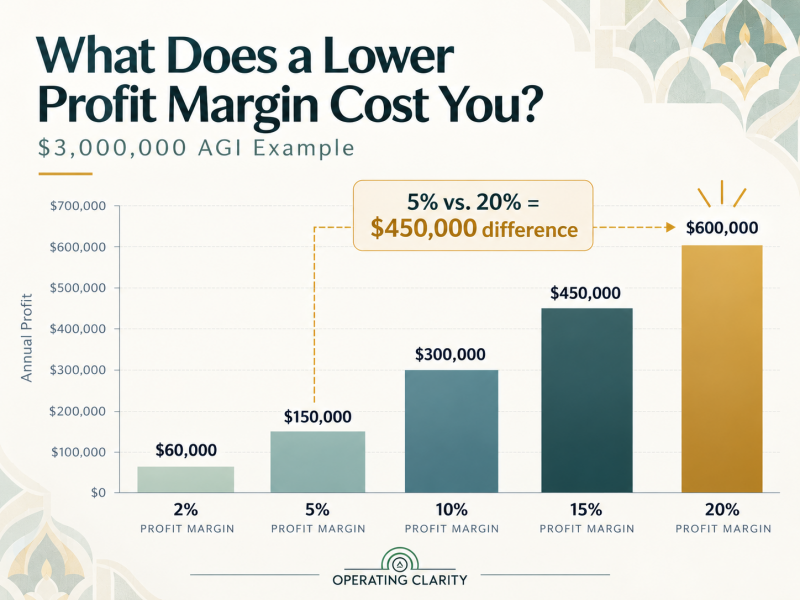
For an agency with $3M in AGI, that's a $450,000 difference between a 5% margin and a 20% margin.
Same agency. Same AGI. A whole lot more money.
I'm not suggesting you can magically go from 5% to 20% by canceling a few software subscriptions and asking everyone to work faster. However, there may be more opportunity inside your existing business than you may realize. Often, it's a series of smaller operational changes that add up to a substantial improvement.
Here are eight places I start looking when helping agencies figure out where their money is going.
1. Client Profitability: Your Favorite “Big” Client Might Be Costing You a Fortune
Most agency owners can tell me exactly how much a client pays them. Ask how much profit they're making on that client, and things get a little fuzzier.
I get it. They might be a major client that pays on time, is nice to work with, and may have an impressive logo to add to your client list. What's not to love? Well, possibly their profit margin.
Some clients look great on paper but require so much attention, so many meetings, or so many extra deliverables that the agency is barely making money on them.
Here's where I look for problems:
- Time tracking: If your team isn't consistently tracking time, you're guessing at client profitability.
- Role alignment: Are account directors spending time on work that account coordinators could handle? Could automation or AI reduce the time required without compromising quality?
- Pricing: Have client rates kept pace with increasing employee salaries and other costs?
- Scope creep: Are you consistently delivering more work than you agreed to?
- Owner involvement: Is the owner's time on client work included in profitability calculations?
- Staffing: Are too many people assigned to an account?
To evaluate client profitability, you need to know what each client pays, the direct outside costs of servicing them, and the hours your team spends on their work.
I generally look for average client delivery margins around 55–65%, although the right target depends on the agency's cost structure and accounting practices. Maintaining this level of client margin ties into your overall 20% AGI for the agency that you are trying to achieve.
Once you have reliable numbers, you can identify which accounts need attention, understand what's driving their costs, and make changes to improve their margins.
For the record, nice clients are still preferable.
2. Scope and Pricing: Stop Giving Away Work for Free
Scope creep deserves its own category because agencies are incredibly good at giving things away.
- A client wants one more revision. No problem.
- An extra meeting? Of course!
- Something that wasn't included in the agreement? Well, they're a great client, so why not?
- Let’s skip the pass through markup costs for this one.
Individually, these requests may not seem significant. But over time, they can consume hundreds of hours your agency never gets paid for.
Let's not forget the retainer you signed three years ago that's still the same price. Meanwhile, your employees have received raises, software costs have increased, and you've added a few AI tools that were supposed to save you money..
Here's what I'd recommend:
- Audit what you originally sold against what you're actually delivering.
- Review retainers that haven't been repriced in more than a year.
- Build annual price reviews or increases into contracts.
- Evaluate markups on outside costs such as media, printing, and software.
- Make sure your agreements account for expenses like stock photography, licensed fonts, travel, and rush work.
- Consider cancellation, delay, and restart fees where appropriate.
I'm not suggesting you nickel-and-dime your clients.
If you want to provide an extra service at no charge, that may be a perfectly reasonable business decision. Just make sure you're doing it intentionally and understand what it's costing you.
3. Team Capacity: Everyone's Busy, but Do You Really Need to Hire?
"We need another person."
If you've run an agency for any length of time, you've probably heard this more than once. Your team is overwhelmed, deadlines are tight, and managers are asking for help. Maybe you do need another employee. Before posting that job opening, though, I'd want to understand what's making everyone so busy.
AMI recommends that agencies generate approximately $175,000 in AGI per full-time equivalent employee, including the owner.
It's a useful benchmark for evaluating whether revenue supports headcount. But it won't tell you why a team is struggling.
Here's where I'd start:
- Look at capacity. Are employees actually at capacity, or is their time being consumed by inefficient processes, meetings, and administrative work? If they aren't tracking all their time, you may not even have an accurate picture of capacity or profitability.
- Evaluate your SOPs. If you don't have documented processes, start creating them. If you do, are people using them? Can the work be simplified or automated?
- Examine how work is assigned. Are senior employees consistently doing junior-level work? Are contractors completing tasks that your existing employees have the capacity and skills to handle?
- Clarify responsibilities. Does everyone know what they're accountable for and which decisions they can make without escalating to someone else? Clear responsibilities and decision-making authority make it easier for managers to delegate instead of getting pulled into every little decision.
- Consider technology. Could integrations, automation, or AI reduce repetitive tasks and free up capacity? Are multiple tools being used that really do the same thing?
And yes, sometimes the numbers reveal that an agency is overstaffed. Nobody enjoys making staffing changes, but ignoring an unsustainable staffing model won't make the business healthier.
Before hiring another person, make sure you're getting the most out of the team and resources you already have.
4. Services and Clients: Not All Revenue Is Good Revenue
Here's a question worth asking: Which of your services actually leave you with the most profit?
You might have a $20,000 project that requires endless customization, senior-level oversight, and multiple rounds of revisions.
Meanwhile, your team delivers another service for $8,000 with a fraction of the effort and a much healthier margin.
Guess which one I'd want to sell more of?
A few things to investigate:
- Which services consistently produce the highest margins?
- Could repeatable services be standardized or productized to make delivery more efficient?
- Are there services with consistently low margins that you should reprice, redesign, or stop offering?
- Could you grow revenue by expanding services with existing clients?
- Does your agency have a minimum client size that makes financial sense?
- Are you overly dependent on one client for revenue?
Of course, you can't accurately compare service profitability if you don't know how much time your team spends delivering each service.
Understanding which services and clients generate the best margins should influence your sales strategy. Instead of simply chasing more revenue, focus on selling the services that generate the most profit.
5. Sales: Yes, You Have to Track Your Time Too
This one doesn't always make me popular with agency owners and sales teams.
If you're asking your delivery team to track time, everyone should be tracking their time. This means your sales team (which may be you) needs to do it, too.
Think about everything that goes into winning a client: discovery calls, research, strategy sessions, proposals, presentations, and follow-up meetings. Now think about the opportunities that don't close. That is time you are paying for.
If your team spends 40 hours preparing a proposal that goes nowhere, the agency has absorbed that cost.
Losing pitches is part of doing business, but you should know what you're spending on them.
Here's what I'd look at:
- Do you have a lead qualification process to avoid pursuing opportunities that aren't a good fit?
- Are you tracking the time and cost involved in winning new business?
- Could proposals, contracts, and research be standardized or supported by AI?
- Are senior employees spending time on sales tasks that could be delegated?
- Are commissions rewarding profitable sales, rather than just sales volume?
Not every opportunity deserves a 40-hour proposal. Knowing what your sales process costs can help you decide which ones are worth pursuing.
6. Quality and Rework: How Many Times Are We Going to Review This?
Revisions are part of agency life, but there's a difference between improving work and repeatedly fixing things that should have been done correctly the first time. If projects consistently go through four or five rounds of internal reviews before reaching the client, I'd want to understand why. Every additional round costs money.
Are creative briefs incomplete or missing important information? Does the team understand what the client expects? Are too many people involved in approvals, or are the same mistakes happening repeatedly?
This is where I start looking at the delivery process itself.
Sometimes the answer is a better brief or a simple QA checklist; other times, it's clearer ownership, better training, or eliminating unnecessary approval steps.
The goal is to find where you can eliminate unnecessary steps that cost your agency money, frustrate clients, and create more work for your already stressed team.
7. Overhead: Do You Really Need All Those Software Subscriptions?
I love a good software platform as much as the next operations person, but I've also seen agencies with an impressive collection of tools that few people use.
Different departments buy different platforms. Employees leave, but their licenses remain active. People sign up to test platforms, but forget to cancel them. Someone signs up for a new tool without realizing another platform already does the same thing, and every month, the credit card gets charged.
This is where I'd conduct a platform audit. I'd look for unused licenses, overlapping software, and subscriptions nobody seems to need anymore. I'd also review vendor contracts and outside services to see if the agency is still getting its money's worth.
I'm not saying you should cancel everything. A $500-per-month platform that saves your team 30 hours of work might be one of the best investments you're making, but a $200-per-month subscription that nobody uses...?
8. Financial Housekeeping: Your P&L Is Trying to Tell You Something
I know. Financial reports aren't everyone's idea of a good time, but if you're running an agency, you need to understand where your money is going.
This isn't something you should only pay attention to when business slows down. In fact, the best time to identify financial problems is when you have the resources and flexibility to do something about them.
AMI's commonly recommended financial model allocates approximately 55% of AGI to people costs, 25% to overhead, and 20% to profit. If your agency's numbers look very different, it's worth understanding why.
Beyond those ratios, I'd look at a few basics:
- Clean up your P&L. Make sure direct costs, employee expenses, and overhead are categorized consistently.
- Separate personal expenses. Your business reports should reflect the actual cost of operating your agency.
- Monitor profitability and capacity. Review client margins and staffing data regularly, not just at year-end.
- Create a financial dashboard. Identify the handful of numbers that tell you whether the business is financially healthy.
Regularly reviewing accurate financial reports helps you recognize problems early and make better decisions about your agency.
Before You Go Looking for More Clients...
Growing an agency with inefficient operations can make existing problems worse. More clients put additional pressure on your team, your processes, and your already thin profit margins.
In my experience, agencies rarely have just one operational issue affecting profitability. It's usually a collection of problems across different areas of the business, many of which have been going unnoticed for years.
Addressing these issues can have a significant impact on your bottom line. You'll also have a business that's easier to manage, less dependent on you, and potentially more attractive to a buyer down the road.
Need help finding or fixing these types of issues?
I work with agency owners to uncover operational problems, identify opportunities to improve profitability, and make the changes that help their businesses run more efficiently.
If you suspect your agency could be more profitable but aren't sure where to start, I'd love to help you work through each of these.